



Celebrity Justice
Dennis Quaid Sues Drug Company

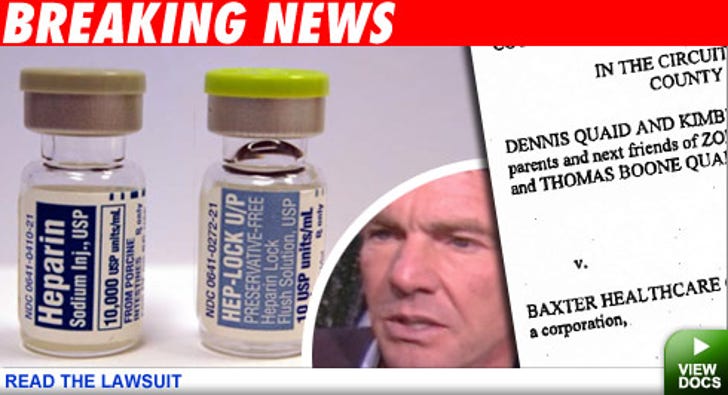
Actor Dennis Quaid and wife Kimberly Buffington have filed suit against Baxter Healthcare Corp., the makers of the drug Heparin.
Click to read the lawsuit!
The couple's newborn twins Zoe Grace and Thomas Boone were mistakenly given a massive overdose of the anti-coagulant drug last month while hospitalized at Cedars-Sinai Medical Center in L.A. The Quaid's attorney says the twins "were very critical for a while," but appear to have recovered and "everything looks good." They filed suit because they want to prevent this from happening to any other children, Loggans said. The suit claims the Baxter is liable and negligent because the packaging of the 10 unit vial of Heparin looks almost exactly as the 10,000-units-per-milliliter vial of the drug.

Three children died in Indiana from a similar mix-up with the drug.

We're told that the Quaids have not sued Cedars ... yet. Just yesterday, Baxter issued a news release outlining the company's new "drug safety initiative" that promises to change the labeling of Heparin vials.

Cedars-Sinai released the following statement:

Cedars-Sinai Medical Center today announced a series of changes it has made in its medication policies and protocols since November 19, as well as immediate additional training of all nursing and pharmacy staff, as the medical center completed its preliminary investigation into a November 18 medication error involving three patients who erroneously received the wrong concentration of heparin (a medication used to prevent blood clotting) to flush their IV catheters.

The medical center's investigation found that preventable errors made by pharmacy and nursing staff caused the wrong concentration of heparin to be used.

A pharmacy technician failed to follow hospital policy of having another pharmacy technician verify the medication and concentration prior to removing it from main pharmacy inventory. As a result, the technician mistakenly retrieved a higher concentration of heparin (10,000 units per milliliter) instead of the lower-concentration heparin (10 units per milliliter) used for flushing IV catheters.

The higher concentration heparin was delivered to the satellite pharmacy that serves the pediatrics unit. A second pharmacy technician, working in the satellite pharmacy, did not verify the concentration of the delivery from the main pharmacy, as required by hospital policy.

As a result, the higher-concentration heparin was placed in a location in the pediatrics unit where the lower-concentration heparin is kept. The nurses who subsequently administered the heparin to the patients also did not follow hospital policy of verifying the correct medication and dose prior to flushing the intravenous site.

The error was identified later that day by Cedars-Sinai staff, who immediately performed blood tests on the patients to measure blood clotting function. In one of the three patients, the clotting tests returned quickly to normal. The other two patients were given protamine sulfate, a drug that reverses the effects of heparin and helps restore blood clotting function to normal. Additional medical tests and clinical evaluation conducted on the two patients found no adverse effects from the heparin or from the temporary abnormal clotting function.

"Although this was a rare event, and attributable to human error, it is also an important opportunity for the entire institution to explore any and all ways we can further improve medication safety," said Michael L. Langberg, M.D., chief medical officer at Cedars-Sinai Medical Center.

"On behalf of the medical center, I extend my deepest apologies to the families who were affected by this situation, and we will continue to work with them on any concerns or questions they may have. This was a preventable error, involving a failure to follow our standard policies and procedures, and there is no excuse for that to occur at Cedars-Sinai," Langberg said.

"Cedars-Sinai's reputation as a quality and safety leader nationally is due in large part to an organizational culture of continually improving our systems to minimize any chance of human error. Immediately following this incident we began additional focused education on medication safety to augment our regular training, and have implemented additional procedures and protocols for our pharmacy and nursing staff," Langberg said.

Among the actions Cedars-Sinai has taken in response to the incident:


► High-concentration heparin (10,000 units per milliliter) has been further sequestered in all pharmacies.

► Only saline will be used for peripheral IV catheter flush on all pediatric patient-care units. (It was already the practice on adult patient-care units to use only saline for peripheral IV catheter flush.)

► In addition to the existing policy of having designated high-alert medications (such as heparin) checked by two pharmacy staff prior to the medications leaving the main pharmacy, and then checked again by pharmacy staff in the satellite pharmacy, a new step requires a second check by pharmacy staff in the satellite pharmacy before they place high-alert medications in stock on a patient-care unit.

► In addition to these checks on designated high-alert medications by pharmacy staff, nurses will continue the existing policy of separately verifying medication and dose prior to giving high-alert medications to the patient.

► The existing ongoing training for pharmacy and nursing staff on medication safety policies and protocols has been augmented with immediate focused education on high-alert medications, begun Nov. 20, to reinforce the hospital's high-alert medication safety policies and protocols:

Starting on the evening shift of November 20:

● All nurses (approximately 1800) were re-trained on high-alert medication policies and practices, and were required to pass a written test on the material before they could resume caring for any patients.

● All pharmacy staff (approximately 200) were re-trained on high-alert medication policies and practices.

► The individuals involved in this incident were immediately relieved of duty pending investigation, and appropriate disciplinary actions are being taken.

Langberg said that Cedars-Sinai is also continuing to cooperate with regulatory agencies investigating the incident, and that Cedars-Sinai would make additional changes in policies and protocols if indicated by the regulatory agencies or any additional findings by Cedars-Sinai.

Reader Comments

(Page 3 of 15) Previous 15 Comments | 1 | 2 | 3 | 4 | 5 | Most Recent | Next 15 Comments

31. too bad the DONT look exactly alike...they dont look anything alike in fact!

Posted at 3:57PM on Dec 4th 2007 by Jason

32. I rhink both parties are at fault...the bottles are virtually i dentical AND the hospital screwed up! He doesnt need the money, but something needs to be done

Posted at 4:05PM on Dec 4th 2007 by Girl

33. I guess most of the people posting comments here are fools. They are suing to prevent this from happening to other families. Obviously they realize that human error caused the actual injuries to the children, but at the same time the reason for the human error is the packaging. So they are going after the underlying cause of the human error! Do you people really think that he needs money and is going to keep it. I bet he donates the winnings to charity or even the hospital or hospitals to help better train people. It's really eye popping to see the number of complete idiots that post assanine comments. I mean what the heck does his career have to do with him suing? They almost lost their newborns. Some people make me sick! Fools I say!!!

Posted at 4:23PM on Dec 4th 2007 by You People Aren't Very Bright

34. To DINA- WHY should the label be in a different color when the people who are administering it are EDUCATED in ADMINISTERING MEDICATION? It isnt like I am sending in a person off the street to start doing IV pushes in the NICU requiring different labeling. For the record the label is similarly colored but NOT the same in color or description. AND... the TOP of the bottle, is a different shade as well and again, these are not COLOR CODED for the average person. They are color coded to the drug they are. You cannot make HEPARIN lables a different color but YOU CAN change the shade to reflect dosage. The whole premise of the lawsuit and the comments on here themselves are because it is laymen commenting on medical standards and systems to which people are obviously not educated on and that is FINE SO LONG AS YOU ARE NOT A DOCTOR OR A NURSE. But if you are a doctor, or a nurse, well now we have a whole other issue. The suit, should be directed towards the hospital because 1- there is probably an error in the entry by the doctor, there is definitely an error by the nurse but the nurses culpability is limited based on what the physician wrote (and by the way ANY nurse who sees anything that completely out of whack would generally call the physician for clarification of the dosage so she is wrong either way) and finally, pharmacy and stock are culpable because there is NEVER a valid reason for HEPARIN to be in the NICU. There is never a reason for that dosage to be in the nursery. In the maternity wing perhaps for the mothers but no way can anyone validate the stock of the HEPARIN over HEPLOCk in that Nicu. NO way. This was a hospital screw up from top to bottom.

The Atty is a friggin idiot and the idea that you are going to change the color of the labels of the SAME FAMILY of medication and create a condition where they are going to be confused for OTHER medications that are NOT in the same family is the most dangerous ideology I have ever heard.

Posted at 3:55PM on Dec 4th 2007 by Lisa

35. Who says nurses are underpaid? Anyway, the bottles are different enough that a trained professional should clearly see the difference, they're labeled differently - the 10K unit is called HEP-LOCK. Anyway, the drug company could use an even more distinctive label, but I don't think it would've made a difference in this case. I think it's true, they're suing because not only does the drug company that makes this have more money than the hospital, but it's always convenient and nice to blame the big bad pharma for everything - it looks good to a jury, since most Americans think that big pharma is evil already.

Posted at 10:44PM on Dec 4th 2007 by LG

36. I agree with #1. The bottle, both in color on the label and cap, are different.
The nurse wasn't paying attention. I'm tell ya, alot of American can't read or can't read well. The illiteracy rate is higher than you think.

I think Quaid will be suing just about everyone.

Posted at 4:06PM on Dec 4th 2007 by stephanie

37. Lisa: They usually do keep them in separate cabinets, but the person stocking the shelves put the bottles in the wrong place, and the nurse didn't double check.

This has happened so many times in other hospitals, I would hold the drug companies partly to blame. How hard is it to the change the label to "DO NOT GIVE TO BABIES" or something? If they had done that after the first time this happened, maybe it wouldn't be happening again and again all over the country in other hospitals.

Posted at 4:01PM on Dec 4th 2007 by Yay

38. These frivolous lawsuits are why health care costs keep rising.
Should drug companies not make drugs to save lives?

Nothing wrong with the drug or labeling,
Perhaps hospitals should start hiring nurses that can read and speak plain english!

Glad the kids are alright though!

Posted at 4:02PM on Dec 4th 2007 by Tiny

39. I am glad someone is doing something! Those babies could have died! Good Dennis
for doing something. It just may save a life. Don't forget others were given the wrong
amount too! Not just Dennis's babies. What 11 more that very day. Someone
needs to step up!

Posted at 4:29PM on Dec 4th 2007 by Leo Woman

40. It's a shame that it has to happen to a celebrity for the Hospital to change their policy.

Posted at 4:05PM on Dec 4th 2007 by Renelle

41. If the hospital had used bar code technology (matching the patient to the drug), this could have been avoided.

Posted at 4:05PM on Dec 4th 2007 by concerned

42. YAY... do you work in the field???? Anyone educated in this industry working in pediatrics would know you do not give HEPARIN to an infant..... the entire premise is ridiculous. These are not LAYMEN bottles they are professional staff bottles and they have a GIANT book called a PDR if they have questions on dosing in medical terminology that they better understand.

I refuse to dumb down my profession by labeling things for laymen. Your rx needs to have instructions on dosing..... for those in the field... if you have a question... look it up in the PDR or even better, KNOW YOUR PROFESSION

Posted at 4:07PM on Dec 4th 2007 by Lisa

43. The insurance money that should be going to add staff to over-worked, understaffed hospitals, are going into the pockets of greedy health insurance executives for private jets and golf trips and lobby money for those equally greedy politicians to look the other way. Mistakes happen ,but more so when there is not enough help

Posted at 4:11PM on Dec 4th 2007 by linda m

44. Everyone here is right, it is short staffing, it is the nursing shortage causing many educational programs to rush students through nursing programs whether 2-yr or 4-yr schools, it is hospitals desparate to get staffing from anywhere, including offering special Visas for foriegn-trained nurses, it is unusually bad oversight protocols in hospitals where the monetary bottom line is more important than quality of care, it is all this and more. But truly, the vast majority of nurses, regardless of their diploma versus Bachelor degree and regardless of U.S.-trained or foreign-trained, really are top notch, dedicated, diligent providers of care. They are human, they make mistakes - this is why they are legally bound in all 50 states to carry personal liability/malpractice insurance just like an MD. Medication errors do occur & thankfully most often in far less serious situation than this Heparin case. The answers will never be found in lawsuits. The answers lie in a deeper more complex problem: health care in the U.S. and the various problems within that larger discussion and thus far neither Democrats nor Republicans truly take it on because they are in bed with lobbyists.

Posted at 4:10PM on Dec 4th 2007 by JCinAZ

45. It's strictly nurse error. Just like it can be doctor error or pilot error. No need to change the label.

Posted at 4:11PM on Dec 4th 2007 by Whatever

Previous 15 Comments | 1 | 2 | 3 | 4 | 5 | Most Recent | Next 15 Comments