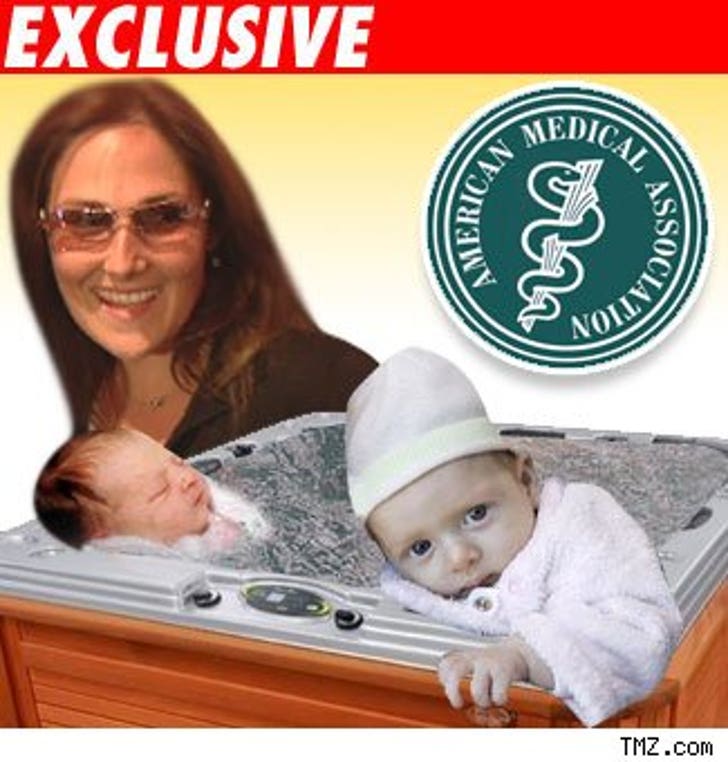




AMA: Ricki Don't Know 'Bout Birthin' No Babies

There's cancer, heart disease, AIDS, and ... did we mention cancer? But the American Medical Association has its scalpels out for that evil medical scourge -- Ricki Lake.

The AMA has issued a resolution slamming Ricki and her pet cause, midwife-aided home-birth baby delivery, as chronicled in her film The Business of Being Born. What's more, they're using Ricki as a tool to get laws passed that would mandate that the "safest setting" for birth is in the hospital ... where OB/GYNs get paid, of course.

Tori Spelling as a suspect mom, we get. But Ricki?


Tags: AMA, Midwife, Ricki Lake, RickiLake, The Business of Being Born, TheBusinessOfBeingBorn

Relevant Posts

Reader Comments

(Page 14 of 14) Previous 15 Comments

196. A good friend of mine made the choice to have her baby at home last month. It died of complications that could have easily been handled in a hospital, with proper staff. I'm headed to the baby's memorial "celebration of life" tomorrow. Just plain tragic. I have to admit, I am a bit upset at her for her "I'm a hippie-vegan, I have to go all natural to prove a point to all my friends and family" decision. Travisty.

Posted at 5:37PM on Jun 20th 2008 by ilovecelebritycrap

197. I believe that even if you have a midwife you should be in a hospital. My entire pregnancy was completely normal but I had to have an emergency c-section when my daughter defecated inside of me and swallowed some of it. She was in ICU for 6 days and I was hospitalized for 4 because I had a fever and they had to make sure I was ok. I'm all for people making their own choices but if a baby dies because medical care is not right there that is something the parents would have to live with. In this day and age why even make that choice? And all the people on here who are knocking the medical field, did you go to a legitimate ob/gyn to make sure the pregnancy was “normal”? Who told you the pregnancy was “normal”? The point is that too many things can come up and with the advances in medicine why would people choose to go back to the dark ages? That’s just my opinion.

Posted at 8:41AM on Jun 22nd 2008 by Trey

198. My son would have died, too, if he had been born at home. It started out as a natural delivery and turned into an emergency C-Section. THANK GOD FOR HOSPITALS!!!!!

Posted at 10:17AM on Jun 22nd 2008 by Jayne

199. I had two wonderful home birth experiences, maybe its not right for everyone but giving birth is a natural process not an illness or emergency health crisis. Thankfully there are Dr.'s and hospitals available when there is an emergency situation during labor and delivery. Most people don't need that much intervention and the C-section rate in this country is outragous.

Posted at 3:46PM on Jun 22nd 2008 by S L Norman

200. Birth is not as dangers as we make it in our minds! We believe far too much of stories told (Klein et al 2006).

Rushing and panic during referral to a hospital reflects not enough knowledge and experiences with home birth of the health provider. Firstly we see by good selected groups of women in the Netherlands, Belgium and Germany not that many problems during normal birth. When there are problems there is the skilled midwife around to spot the problem, guide the referral and manages the stress around. There is always time to travel without panic to a hospital for help. I have guided 2500 births in the home and hospital environment and know some about.
The more knowledge of-, experience with- and trust in NORMAL BIRTH there is, the better the outcome. It is all about mindset for NORMAL BIRTH. We can look in this perspective better to the outcome of the research of Johnson & Daviss in 2005 in the USA and Canada (Johnson & Daviss 2005).
All the talking about the need to rush, making noise and panicking is most times a reaction about insecurity and fear in the person which guides the birth. So it has much to do with perception of risk, not having experiences with normal birth and reflects as well no trust in women (these care providers mostly have a biomedical vision on birth) and no trust in normal birth (Rockel – Loenhoff 2006).
This all can we place in the perspective of the 'fish can't see water' syndrome (Wagner 2001 and on internet), see for full text http://www.acegraphics.com.au/articles/wagner03.html

The Johnson & Daviss study proves that homebirth with certified and well trained midwives is very save for women in the USA and Canada. We can also conclude that women do not determine the outcome of birth (Johnson & Daviss 2005). Women are very capable to give birth normal. We see that hospitals are the places where outcomes of normal birth are bad. There, in hospitals, is different approach and do we see many unnecessary interventions and too much control of the normal and physiological process which actually only needs time (Tracy et al. 2007). During birth women need a save place (nest) and must have the freedom to move and follow instincts. Therefore home birth with a know midwife is a better environment for birth even in industrialised countries like the Netherlands. We see by home birth with no more than two certified by the women involved known midwives (relation building is one of the keys for success of women) less interventions, less referrals and higher satisfaction of women (Johnson & Daviss 2005), (Rockel – Loenhoff 2006), (Fontein 2007).

Lorena Davis (2005) identifies the results of the Johnson & Daviss study this way: ‘With evidence like the Johnson & Daviss, 2005 to support the argument for planned and supported homebirth, we now need to concentrate on how we counter the current fear driven, blame focussed, risk managed care that is endemic in childbirth care provision throughout the western world and beyond. Many women, midwives and medical practitioners are fearful of the process of birth. Consequently reassuring them and ameliorating their fears will remain a long and uphill struggle’ (Davis 2005).

Doctors and hospital personal can learn from women giving birth spontaneously, but their medicalized and sometime large ego’s and fear are in place. ‘By listening to women’s stories, birth becomes more ordinary and less frightening. It becomes more down to earth, yet more precious, than we could possibly have imagined’ (O’Connor 1995).

Now it is time we give doctors space to move or grow into a more transformational role in obstetrics. We can work together, but have to face that we both see birth from a different perspective. It will take time to bridge the gab. But never forget we all have in mind that women deserve the best. There is so much to win and we still do communicate….
Time is our help in every move and stage of life, it's like birth …..

The ancient Chinese proverb dating back to the fifth century BC, attributed to Lao Tzu age, teaches ……

’You are assisting at someone’s else’s birth.

Do good without show or fuss. Facilitate what is happening rather than what you think ought to be happening. When the baby is born, the mother will rightly say: ‘we did it by ourselves’. ‘

• Davies Lorna D (2005) BJM 2005 bmj.com. Rapit respons, 21 06 2005.
• Johnson K C Daviss, B (2005). Outcomes of planned home births with certified professional midwives: large prospective study in North America. BMJ;330:1416 (18 June), doi:10.1136/bmj.330. 7505. 1416.
• Fontein Y (2007). LESS IS MORE. Differences between practices: a survey of women’s views of Dutch midwifery care. Master thesis. Department of Nursing, Midwifery & Community and Health. Glasgow Caledonian University.
• Klein M C, Sakala C, Simkin P, Rooks J P, Pincus J, Davis –Floyd R (2006) Roundtable discussion: Part 2. Why do women go along with this stuff? Birth. 33:3:245-50.
• O’Connor M (1995). Birth Tides. Turning towards homebirth. London: Pandora.
• Rockel – Loenhoff A (2006). Wie viel Techniek braucht die Hausgeburt? Deutsche Hebammenzeitschrift. 6:23-25.
• Tracy S K, Sullivan E, Wang Y A, Black D, Tracy M (2007). Birth outcomes associated with interventions in labour amongst low risk women: A population-based study. Women Birth. 26 [Epub ahead of print].
• Wagner M (2001). Fish can't see water: the need to humanize birth International Journal of Gynecology and Obstetrics. Volume 75, Supplement 1, November 2001 , pp. 25-37(13)

Posted at 6:49AM on Jun 23rd 2008 by Christine Oudshoorn

201. Check your facts Diane. Fetal and maternal mortality rates have NOT gone down. We are one of the worst countries in the world and our rates continue to climb. We also have an outrageously high and dangerous cesarean rate. Hospital-based obstetrics are not research-based, they are liability based (what looks good in court). Having a baby at home is not risky, having a baby in the hospital is a considerable risk with all of their overused interventions without informed choice. For all of you who feel like you or your baby might've died at home, consider how interventions may have played a part in your birth outcome. Induction, epidurals, artificially breaking the water, augmentation, episiotomy, vacuum extractions, etc. are all very risky and dangerous procedures that carry a long list of well-known complications. A combination of interventions leading to a cascade of complications is the most likely reason for an emergency. Birth at home is just as safe and many times safer than in a hospital. Kudos to Ricki for finally presenting these facts in a mainstream format so that so many others could challenge commonly based practices that are leading to fetal and maternal mortality rates being so incredibly high in the U.S.

Posted at 1:09PM on Jun 25th 2008 by Emily

202. For goodness sake! Have your baby at home it's cleaner and less stressful! If I would of had better sense 18 years ago, my children would of been born at home!!! They wouldn't let me walk, get out of bed, I mean why not. Why couldn't I get up. I was healthy? So ladies get a Midwife have your baby with your family there to support you.

Posted at 12:26PM on Jun 25th 2008 by Theresa Welch

Previous 15 Comments