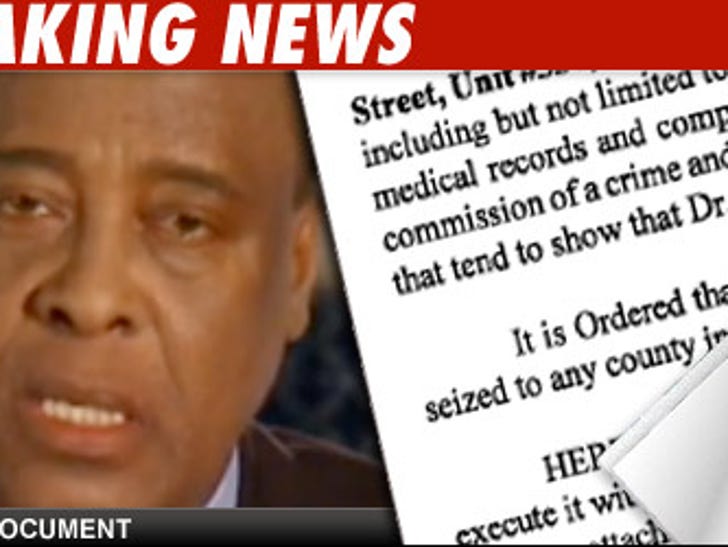




Jackson Died from Lethal Levels of Propofol

Michael Jackson had lethal levels of Propofol in his system when he died, this according to a search warrant affidavit filed in Houston.
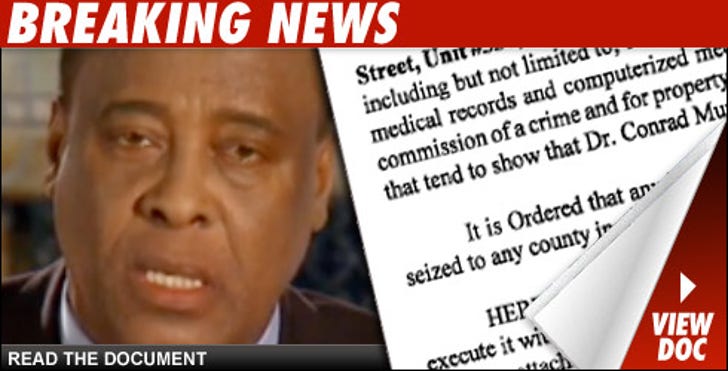
Dr. Conrad Murray

Dr. Conrad Murray
told cops he had been treating Jackson for 6 weeks for insomnia -- giving him 50 milligrams of Propofol every night through an IV.

Murray told cops he feared Jackson was getting addicted so he reduced the dosage to 25 mg.

The morning Jackson died, Dr. Murray gave Jackson valium at 1:30 AM. Murray said the valium didn't work so he gave the singer an IV injection of lorazepam -- an anti-anxiety drug. Murray told cops Jackson was still awake, so he then gave him midazolam -- a sedative.

Murray gave Jackson more drugs. He says at 10:40 AM, he administered 25 mg of Propofol. Dr. Murray told cops Jackson repeatedly demanded the drug.

As we first reported, cops found 8 bottles of Propofol in Jackson's house after he died, but they do not know where it was purchased.

Cops also found Valium, Tamsulosin, Lorazepam, Temazepam, Clonazepam, Trazodone and Tizanidine, along with the Propofol.

The various drugs were prescribed by Dr. Murray, Dr. Arnold Klein and Dr. Allan Metzger.

Dr. Murray reportedly told cops 10 minutes after administering Propofol ... he "left Jackson's side to go to the restroom and relieve himself. Murray stated he was out of the room for about 2 minutes maximum. Upon his return, Murray noticed that Jackson was no longer breathing."

Dr. Murray says he began CPR and at some point ran downstairs and asked the chef to send up Prince Jackson, the eldest son, then Murray continued performing CPR.

Dr. Murray says he noticed that Jackson wasn't breathing at around 11 AM. He was then on the cell phone for 47 minutes with 3 separate calls, from 11:18 to 12:05. The 911 call came in at 12:21 PM .... a much longer delay than originally reported.

Dr. Murray told cops other docs had administered Propofol to Jackson, including Las Vegas Dr. David Adams. Dr. Murray said he was at a cosmetologist's office where Dr. Adams gave Jackson Propofol.

Interestingly, according to the warrant, Dr. Murray refused to sign the death certificate at the UCLA Medical Center.

UPDATE:
If Dr. Murray is charged with a crime, there's a statement in the affidavit that could be evidence of a consciousness of guilt. The document also states both "UCLA doctors and L.A. Fire Dept. paramedics stated that Dr. Murray had only disclosed that he had given the medication Lorazepam [Ativan] to Jackson prior to his medical emergency." Dr. Murray did not disclose that he had given Jackson Propofol.


Reader Comments

(Page 1 of 1)

1. I'm amazed by the amount of people who seem to need to repeatedly make the same disturbing message over and over again - a few words may be different, but the sentiments are extremely consistent:
[i](The excerpts in quotes are representative, not taken verbatim or directly from any specific person or post.

There are enough of them, though, to generalize with reasonable accuracy, as anyone who's read more than a few pages of comments has also discovered).[/i] formatting attempt is wholly experimental. I'm guessing it will fail... no matter....

Example:
"Michael Jackson was an (addict, junkie ______ insert derogatory name desired, but the two listed seem to be favorites)."
-------------------- I agree with this one to a point. There is every indication that Mr. Jackson was suffering from some form of addiction/addictions - sadly, it seems more and more likely that one or more of these were very serious. And this is where my agreement with these comments ends, including to my reaction to such information.

"I'm glad Michael Jackson is dead, because he was an addict."
-------------------- I found the prevalence and repetition of this sort of comment absolutely stunning.

Being glad that someone is died unexpectedly, and is dead - possibly due to criminally chargeable offenses - actions of credentialed , in-home physician, that were far from inevitable, likely very preventable but weren't - is absolutely horrifying. How does one 1) decide this particular reaction is the one they like most, and 2) what thought process - or lack thereof - does one go through to conclude that this perspective is not only one they like, but the best one that they deliberately make the effort to share with others - repeatedly, with little variation... and 3) to what end??

"Not only do I think it's GREAT that this addict/junkie is dead, but he is solely responsible for his own death. He was an addict/junkie who cared about his drugs more than his children, and there is no one to blame for his death than Michael himself (who, did I mention - was a junkie? Or addict? There is nothing more sinful, immoral or proof that the junkie is so worthless they don't deserve the right to keep breathing, and if ends up doing something that causes them to stop breathing - it's really no big deal because it's their fault, they deserved it and that they are no longer alive just fills me with joy."
------------------------- (name-calling is always a reliable indicator that the surrounding words/sentences are probably not worth reading, even if such insults are somewhat creative or witty, neither of which is present in the automated "junkie" and/or "addict". Even so, the entertainment level of such is dubious at best, and only if more witty than mean - but such subtleties are clearly foreign to the junkie crowd.

* * *
One of the most puzzling and creepy thing about these comments is how someone ends up with the thought that someone's - anyone's addiction, misfortune, tragedy, failure, crisis, eccentric/bizarre public persona... etc. is in ANY way rational or appropriate reason to view this person's (at best) accidental or negligent death.

How does anyone actually find themselves to somehow possess whatever qualifications they imagine to have that they believe their judgment of a stranger's life - a condemning judgment disapproving of one or many things about this person that is so harsh that this self-appointed judge concludes that this person was so worthless and flawed that they shouldn't be alive. Of course, any "good" person like themselves would have beat those addictions long ago, being "good" and all - oh and free of any addiction or dependence since birth... (either that or just not get caught - or get caught dead).

Imagine if people who think this way actually had the power to decide the fate of others - and choose who deserves to live or die based on whether their dislike for someone's lifestyle or unsuccessful battle with addiction. The population would get pretty sparse pretty fast... being glad someone is dead because they don't act like you do - Man, I must be condemned, too, I never want to be like - or be near - anyone who is capable of such thinking. Even if it's an annoying, disturbed group joke of some sort - doesn't change much for me. It's horrific either way.

I can't believe people are publicly stating their pleasure that someone is dead because of a chemical dependency he likely would have given anything to be free of... that his addiction is not only somehow indicative of immorality (I think being gleeful about a tragic death of someone they judge based on biased assumptions from websites and magazines. That is the freaking epitome of the total, deliberate absence of compassion, empathy and a most twisted sense of morality (so much so in fact, it is in fact the opposite of such).

Why?

Posted at 9:36AM on Aug 25th 2009 by cake